


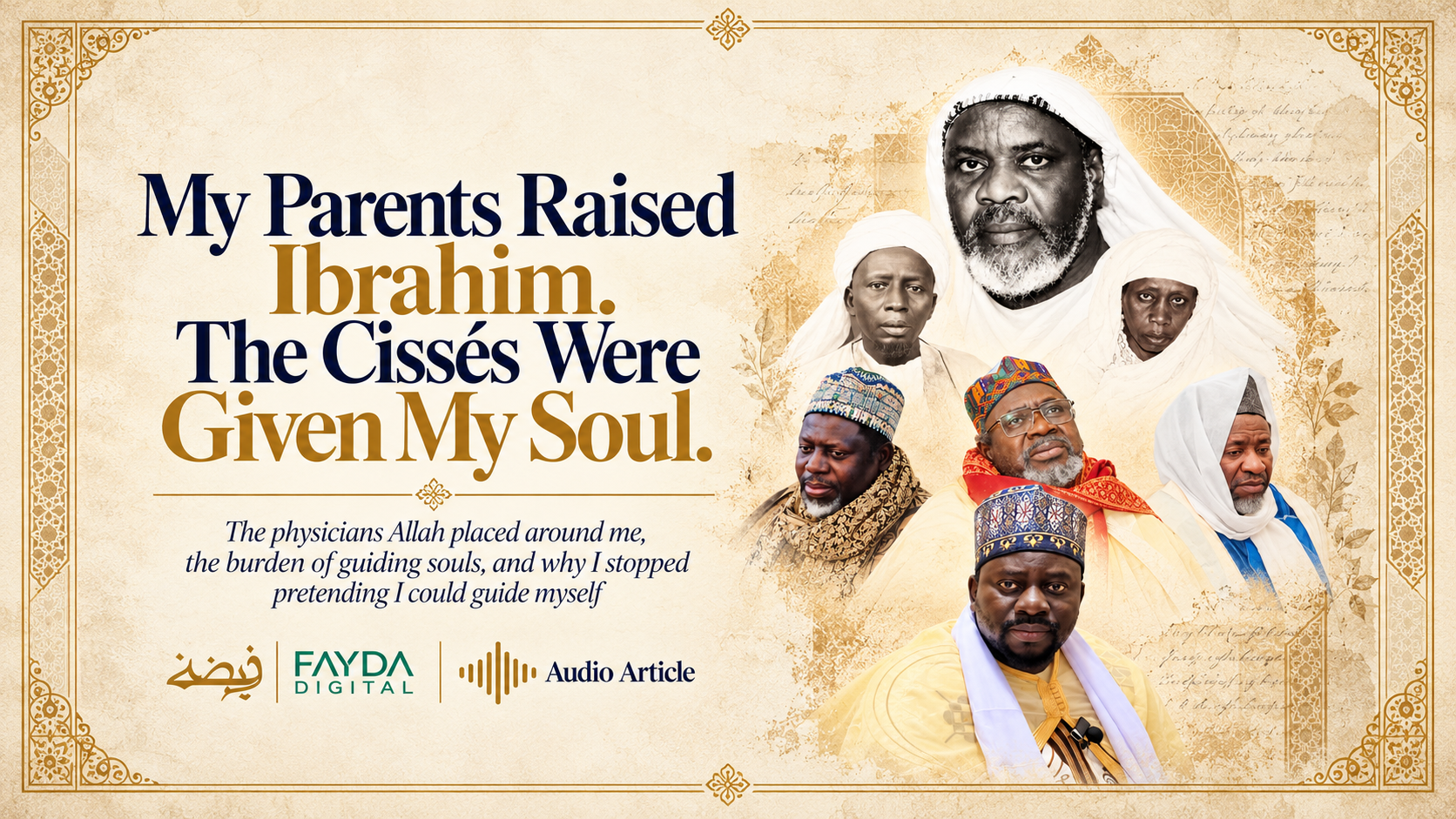
Journal Entry III — On the physicians Allah placed around me, the burden of guiding souls, and why I stopped pretending I could guide myself
My parents raised Ibrahim.
They gave me what parents give when Allah allows them to give well.
Blood.
Name.
Home.
History.
Discipline.
Love.
A sense of who I was supposed to be before I was old enough to understand how difficult becoming that man would actually be.
I owe them debts I will never fully repay.
So when I say that the Cissés were given my soul, I am not diminishing my mother or my father.
I mean something entirely different.
There came a point in my life when the problems inside Ibrahim had become too complicated for parental love alone.
My parents could love me.
Warn me.
Pray for me.
Correct me.
Be disappointed in me.
Forgive me.
But there were places inside me where even their love could not reach.
Places where the nafs had become intelligent.
Places where sin knew my name.
Places where ego could put on religious clothing.
Places where I could sincerely believe I was right and still be deeply wrong.
Those places required specialists.
Allah gave me physicians.
And somehow, through different stages of my life, He gave them to me through one extraordinary family.
The Cissés.
I need to say something early so there is no confusion about what I am writing.
This is not an advertisement for the Cissé family.
I am not telling anyone that they must have my Shaykh.
I am not proposing that Allah guides every servant through the same people or even through precisely the same form of spiritual relationship.
I am telling you what Allah did with me.
And I will not diminish these men merely to make someone else comfortable with the intensity of my love for them.
I love them.
I revere them.
I believe they are extraordinary servants of Allah.
And I believe the family from which they come carries an extraordinary inheritance and an extraordinary responsibility.
But they are servants.
That distinction is everything.
Their greatness does not compete with Allah.
Their greatness, when properly understood, points toward Him.
---
I have become increasingly suspicious of any man who is completely certain he can guide himself.
Especially when that man is me.
That may sound strange coming from someone who believes completely in Qurʾān and Sunnah.
But the older I become, the more I realize that saying “Qurʾān and Sunnah” is not the difficult part.
The difficult part is the human being claiming to follow them.
The Qurʾān may be clear.
The Sunnah may be clear.
Ibrahim is not always clear.
I can read about humility and remain arrogant.
I can memorize the command to forgive while maintaining a private prosecution against somebody.
I can know the rules of commerce and still somehow find an exception convenient enough for my particular circumstances.
I can teach tawakkul while panicking.
I can know exactly what the Prophet ﷺ taught and still produce an intelligent explanation for why Ibrahim's situation should somehow be treated differently.
That is what frightens me about the nafs.
It is not stupid.
Mine certainly isn't.
It can read.
It can quote.
It can reason.
It can sound sincere.
It can even become religious.
So the real question is not whether revelation is sufficient.
Of course it is.
The question is:
Is Ibrahim sufficient to interpret Ibrahim?
After living with him this long, my answer is no.
---
If something complicated were happening inside my body, I would not diagnose myself simply because I owned a medical textbook.
If a scan showed something strange in my chest, I would want a cardiologist.
Something in the brain, a neurologist.
Cancer, an oncologist.
I would want somebody who had spent years learning how to see what ordinary eyes cannot see.
Yet somehow when the patient is the soul—
the part of me capable of turning pride into dignity,
fear into strategy,
revenge into justice,
control into leadership,
and ego into “principle”—
I am supposed to trust myself completely.
That has never made sense to me.
The body can have specialists.
Why should the soul need none?
---
That, for me, is part of what a real Shaykh is.
Not another object of worship.
Not a replacement for Allah.
Not a replacement for the Messenger of Allah ﷺ.
A specialist.
A physician of diseases that are difficult to see precisely because the disease lives inside the person doing the looking.
The Shaykh does not invent the medicine.
The medicine is Qurʾān.
Sunnah.
Dhikr.
Adab.
Tawbah.
Discipline.
Knowledge.
Prophetic character.
The Shaykh is judged by how faithfully he carries that medicine and how skillfully he helps the patient receive it.
A legitimate Shaykh should make me more surrendered to Allah.
More faithful to Qurʾān.
More recognizable in the character of Sayyidinā Muḥammad ﷺ.
More suspicious of my own nafs.
More useful to creation.
If twenty years around a Shaykh leaves me merely obsessed with the personality of the Shaykh but no more truthful, humble, merciful or obedient to Allah, then something has gone wrong.
The destination was never the physician.
The destination is health.
---
But I have also come to understand something else about the physician.
Somebody has to carry the patients.
That is the part we romanticize far too easily.
We see the Shaykh sitting.
We see the gathering.
The white clothes.
The people kissing hands.
The photographs.
The respect.
The thousands of people saying his name.
What we often do not see is the burden.
And I have seen enough of it that sometimes, in an almost ironic way, I feel sorry for my Shaykhs.
Not because their station is something to pity.
Allah forbid.
I mean I sometimes look at what human beings bring to them and think:
Yā Allah. What an amānah.
Because what exactly have these men volunteered—or been called—to deal with?
Us.
Human beings.
Perhaps the most complicated patients in creation.
People arrive carrying marriages.
Divorces.
Children.
Money.
Addictions.
Jealousy.
Religion.
Business disputes.
Grief.
Ego.
Questions about Allah.
Questions about sex.
Questions about inheritance.
Questions about prayer.
Questions about whether they should marry someone.
Questions about whether they should leave someone.
Family wars twenty years old.
Young people losing faith.
Old people afraid of death.
Murīds convinced they have reached spiritual stations that everybody around them can clearly see they have not.
People who want duʿāʾ.
People who want money.
People who want introductions.
People who want access.
People who want miracles.
People who want the Shaykh to bless the decision they already made.
And somehow the Shaykh is expected to listen through all of it and still locate the soul.
That is an enormous responsibility.
---
These are servants of Allah who have accepted the burden of trying to guide other servants with Qurʾānic and Prophetic guidance.
Think about that seriously.
They are dealing with human beings—
creatures Allah has honored, creatures capable of extraordinary nearness to Him and extraordinary distance, creatures carrying free will, appetites, trauma, intelligence, ego, faith, doubt and an almost limitless capacity for self-deception.
And a murabbī accepts responsibility for helping such a creature navigate his own nafs.
I would not want that job.
I say that with all sincerity.
Because if Ibrahim is only one patient, I already know how difficult Ibrahim can be.
Imagine thousands of us.
---
I have witnessed some of the personal sacrifice.
Time that does not belong to them anymore.
Telephone calls.
Messages.
Travel.
People waiting.
People arriving.
People needing.
Expenses.
Conferences.
Communities.
Families requiring support.
Students requiring guidance.
Institutions requiring money.
People assuming that because a Shaykh serves everyone, somebody else must surely be paying for the service.
Often that assumption is wrong.
I have watched enough to understand that spiritual leadership is not merely a position of honor.
It can become a financial burden.
A family burden.
A physical burden.
A psychological burden.
A burden on privacy.
A burden on time.
A burden that follows you through airports.
Into hotel rooms.
Into meals.
Into the few minutes another person might call rest.
And still somebody needs the Shaykh.
Sometimes that somebody is me.
That realization makes me love them more.
But it also makes me more careful.
Because reverence should not become entitlement.
The fact that somebody has accepted responsibility for serving souls does not mean every soul acquires ownership over his time.
That is another adab I am still learning.
---
When I look backward across my life, I see something almost embarrassing in Allah's generosity.
At different stages, He kept placing around me the kind of spiritual medicine the Ibrahim of that stage seemed to require.
And these men came through one family.
The house of Sīdī ʿAlī Cissé.
I cannot speak about the sons and descendants who shaped me while treating their patriarch like a historical footnote.
Sīdī ʿAlī stands behind the architecture of this story.
His closeness to Shaykh Ibrāhīm Niasse.
His service.
His knowledge.
His responsibility.
The trust Baye placed in him, including, as transmitted in Baye's final testament, entrusting his own family to his care.
That matters.
It tells me that what I encountered later through Shaykh Hassan, Imam Shaykh Tijani, Shaykh Mahy and Shaykh Seydi did not begin when Ibrahim happened to meet them.
I entered an inheritance already in motion.
A household formed around knowledge, service, sacrifice, Tarbiya and Fayda long before I ever needed anything from it.
And I needed plenty.
---
Shaykh Hassan — the mercy that first received me
Shaykh Hassan Cissé became, for me, the motherly presence of my spiritual life.
Jamāl.
Beauty.
Mercy.
Nurture.
Warmth.
Shelter.
I know that language can be misunderstood.
I do not mean weakness.
I do not mean softness without discipline.
I mean the quality by which a wounded person begins to believe that he is still worth treating.
There are stages of life when severity does not correct you.
It merely confirms the worst thing you already suspect about yourself.
That you are bad.
Finished.
Too far gone.
Beyond repair.
Sometimes before a soul can survive serious correction, it first needs to believe there is something inside it worth correcting.
Shaykh Hassan gave me something like that.
---
There was a way he could make Islam feel like home.
Not because Islam had ever stopped being home.
Because Ibrahim had wandered far enough to forget the address.
I was young.
Complicated.
Capable of devotion and foolishness almost in the same breath.
And there was something in Shaykh Hassan's Jamāl that did not make me feel that my contradictions had placed me outside Allah's concern.
That was medicine.
I did not know to call it that then.
I simply knew that I loved him.
That I felt safe near him.
That somehow I wanted to be better around him without feeling that I first had to pretend I already was.
Before my soul could endure being fathered, perhaps it first needed to be mothered.
Before discipline could work, love had to convince me not to run.
---
Shaykh Hassan did not make me righteous.
No human being carries that responsibility for another.
I fell.
I made mistakes.
Serious ones.
But love can place something inside a person that survives even after the person who gave it returns to Allah.
There are moments now when I still find myself asking:
What would Shaykh Hassan have seen in this?
Not merely:
What would he have said?
What would he have seen?
Because sometimes a spiritual parent can see possibility behind conduct.
The child behind the crime.
The future behind the mess.
Maybe one of Shaykh Hassan's gifts to me was that he saw enough possibility in Ibrahim that eventually Ibrahim began feeling responsible for the possibility he had been shown.
Then Shaykh Hassan returned to Allah.
And the medicine changed.
---
Imam Shaykh Tijani — the father who expects me to stand
Allah did not give me another Shaykh Hassan.
That itself became part of my education.
He gave me Imam Shaykh Tijani Cissé.
The brother of the man whose Jamāl had mothered my soul.
And by then, I was no longer the same Ibrahim.
I was older.
Prison had happened.
Life had happened.
Now there were children.
Marriage.
Family.
Business.
Community.
People depending on me.
People calling me things that sound much more impressive than the man hearing them knows himself to be.
A grown man cannot spend his entire life being held.
Sometimes he needs to be told:
Stand up.
Carry it.
Finish it.
Stop explaining.
Endure.
That is where I experience Imam Shaykh Tijani.
Jalāl.
Fatherhood.
Authority.
Discipline.
Responsibility.
Again, these are my experiential categories.
Shaykh Hassan could be severe.
Imam Shaykh Tijani possesses immense mercy.
I am explaining what Allah made their roles become inside Ibrahim.
Shaykh Hassan often made me feel that I could still become something.
Imam Shaykh Tijani makes me answer for what I am becoming.
---
There is something particularly important about having a Shaykh when you are already a grown man.
The world may call you Founder.
Executive.
Chairman.
Leader.
People may ask your opinion.
You may walk into rooms where people assume you know what you are doing.
Then you sit before somebody who has absolutely no obligation to be impressed with the story you tell the world about yourself.
That is healthy.
Every man needs somewhere his résumé stops working.
For me, part of the blessing of Imam Shaykh Tijani is that I do not need him to be impressed with Ibrahim.
I can find people who are impressed.
That is not difficult.
I need someone concerned with whether Ibrahim is actually becoming a servant of Allah.
Those are completely different responsibilities.
---
And when I think about the weight Imam Shaykh Tijani carries as Imam al-Fayda, the fatherly metaphor becomes even heavier for me.
Because fatherhood is not merely authority.
Fatherhood is carrying.
People see command.
The father feels responsibility.
The number of people who look toward him, seek him, depend upon him, need guidance from him, need representation from him, need decisions from him—
I have seen enough of that reality to understand why I sometimes hesitate before adding Ibrahim's latest personal crisis to the pile.
The father of the soul has other children.
Many.
That realization itself teaches adab.
---
Shaykh Seydi — when Allah gives you a teacher you can speak to like a brother
Then there is Shaykh Seydi Cissé.
The word brother can accidentally diminish what I mean, so I want to be precise.
I am older than Seydi.
That means almost nothing spiritually.
I give him complete deference in knowledge because I regard him as a complete scholar and a complete Shaykh.
His knowledge is immense.
His wisdom is real.
And one of Allah's unusual gifts to me is that the same person before whose scholarship I can sit as a student has been placed close enough to me that I can approach him with the intimacy of a brother.
That combination is rare.
---
There are scholars whose knowledge you admire from far away.
You hear them lecture.
You read them.
Perhaps you get five minutes after an event.
Then there are teachers Allah places near you at a stage when they still have that precious thing almost every serious scholar eventually loses:
time.
Time to sit.
Time to listen.
Time for one question to become four.
Time for me to say:
No, that's not exactly what I mean.
Let me tell you what actually happened.
Time for the polished religious question to collapse and the embarrassing real question to finally emerge.
That is part of what Seydi has been for me.
And I know enough about life to understand that this access itself is temporary.
Responsibilities grow.
Communities grow.
People discover a scholar.
Then his time begins belonging to everyone.
So I recognize the blessing while Allah has placed it in front of me.
---
With Seydi, I can go deep.
Sharīʿa.
Ṭarīqa.
Tarbiya.
Questions about the Path that cannot be solved by slogans.
Questions where fiqh, spirituality and ordinary human life crash into each other.
Marriage.
Business.
Ethics.
Money.
Intentions.
Relationships.
Questions too complicated for a social-media quotation.
Questions I might hesitate to place before Imam Shaykh Tijani simply because I am conscious of the enormous responsibility Imam al-Fayda carries.
With Seydi, I can arrive before the question has learned how to behave.
No performance.
No unnecessary ceremony.
I can defer without becoming guarded.
That is extraordinary to me.
---
And Imam Shaykh Tijani is not merely Seydi's biological father.
He is also his Shaykh and murabbī.
That matters.
Because I am not looking merely at someone who inherited a respected surname.
I am looking at someone who himself sits under discipline.
Who is being formed within the same transmission through which he helps form others.
The biological and spiritual lineages meet.
Father.
Shaykh.
Murabbī.
That tells me something important about spiritual inheritance.
Blood can place a man inside a family.
It cannot manufacture knowledge.
It cannot manufacture adab.
It cannot manufacture Tarbiya.
Those require work.
---
If Shaykh Hassan represents Jamāl in the architecture of my soul, and Imam Shaykh Tijani something of Jalāl, Seydi has come to represent something I personally think of as Kamāl—
not as a doctrinal declaration about his maqām,
but because of the completeness I experience in the relationship.
Teacher and brother.
Scholar and confidant.
Deference and intimacy.
Sharīʿa and lived reality.
The formal and the unguarded.
Sometimes guidance comes from above you.
Sometimes Allah lets it sit beside you.
---
Shaykh Mahy — the revered uncle who carries far more than Ibrahim sees
Then there is Shaykh Mahy Cissé.
My personal experience of him carries the feeling of the revered uncle.
Quiet encouragement.
Warmth.
A word here.
A word there.
The kind of presence that can strengthen you without needing to dominate the room.
But “uncle” describes my experience of him.
It does not describe the magnitude of the Shaykh.
Shaykh Mahy is a major Shaykh.
A Shaykh al-Murabbī for many American Tijānīs.
Men and women have entrusted their Tarbiya to him.
That includes somebody as close to me as blood can make a person:
my biological brother Osman.
That matters deeply to me.
---
I can experience Shaykh Mahy with the ease of an uncle and simultaneously watch my own brother relate to him through the seriousness of Tarbiya.
The man who quietly encourages Ibrahim is, for another person, directly responsible for helping diagnose and treat the nafs.
That reminds me never to confuse accessibility with lack of rank.
Family with informality.
Warmth with lightness.
And when I see the responsibilities these men carry for other human beings, the physician metaphor stops being romantic.
A murabbī has patients.
And the patients go home.
Have crises.
Fall.
Return.
Call.
Need.
Sometimes at two in the morning.
Sometimes across oceans.
Sometimes without the ability to pay for the journey the Shaykh is making partly for them.
This is the part of spiritual leadership people rarely photograph.
---
I have watched enough of their world to understand that Prophetic inheritance is burden before it is prestige.
If you tell people that someone is an inheritor of the Prophet ﷺ, people hear honor.
Of course it is honor.
But what did the Prophet ﷺ carry?
People.
Their guidance.
Their ignorance.
Their questions.
Their grief.
Their opposition.
Their hunger.
Their disputes.
Their hopes.
Their souls.
So when a servant accepts any portion of that work—not Prophethood, which ended with Muḥammad ﷺ, but the responsibility of teaching and guiding according to what he brought—why would we imagine that inheritance would be comfortable?
Sometimes when I watch my Shaykhs, I see something that makes the title Shaykh feel less glamorous.
I see cost.
And I think:
May Allah help them with us.
I mean that.
---
So when I look at these men together, I am not assigning cute family roles to famous religious personalities.
I am recognizing how Allah allowed serious scholars and spiritual authorities to reach me through forms of intimacy my soul already understood.
Shaykh Hassan:
the Jamāl that received and nurtured.
Imam Shaykh Tijani:
the Jalāl that demands responsibility from the grown man.
Shaykh Seydi:
the complete scholar and Shaykh whose knowledge commands my deference and whose proximity permits unusual brotherly candor.
Shaykh Mahy:
the major murabbī whose spiritual responsibility reaches deeply into the American Tijānī community and even into my biological family, while personally touching me through the reassuring presence of an elder uncle.
And behind all of them:
Sīdī ʿAlī Cissé.
Baye Niasse.
And ultimately—
Sayyidinā Muḥammad Rasūlullāh ﷺ.
That direction is everything.
---
If a spiritual chain stops at the personality of the Shaykh, something has gone wrong.
The Shaykh must point beyond himself.
Toward the Messenger ﷺ.
And the Messenger ﷺ leads creation toward Allah.
Always Allah.
That is why I find the accusation that love for a Shaykh necessarily equals worship so intellectually shallow.
No.
I worship Allah.
Full stop.
Lā ilāha illa’Llāh.
No Shaykh is Allah.
No Shaykh shares Allah's divinity.
No Shaykh independently controls my destiny.
No Shaykh deserves ʿibādah.
No Shaykh replaces Muḥammad ﷺ.
No Shaykh may overturn Allah's law.
The Shaykh is a servant.
A teacher.
A guide.
A physician.
And when Allah favors him, a carrier of Prophetic knowledge, wisdom, character and responsibility.
That is immense.
But immense is not Divine.
---
I sometimes think people confuse love with worship because religious love makes them uncomfortable.
Yet the same people understand intense attachment everywhere else.
A man can scream until he loses his voice because an athlete entered an arena.
People memorize the habits and opinions of celebrities they have never met.
They quote professors for thirty years.
They speak about deceased parents with reverence.
They shape whole intellectual lives around scholars.
We understand all of that as admiration, loyalty, love or influence.
Then a murīd speaks intensely about his Shaykh and suddenly somebody announces:
Worship.
That is too crude.
The actual creed question is not:
How much do you love him?
It is:
What do you believe he is?
Those are not the same question.
I can love a servant of Allah deeply while knowing with absolute certainty that he remains a servant of Allah.
In fact, part of what I love about these men is precisely their servanthood.
The burden they carry is not evidence of divinity.
It is evidence of service.
---
Can murīds become excessive?
Of course.
Human beings can become excessive about almost anything.
Some say things badly.
Some imitate without understanding.
Some use language requiring correction.
Correct the excess.
But do not use the excess of one lover to criminalize love itself.
And there is an opposite excess that receives far less scrutiny.
The arrogance of believing you need nobody.
“I only need Qurʾān and Sunnah.”
Fine.
Who taught you Qurʾān?
Who taught you Sunnah?
Who corrects your misunderstanding?
Who tells you the “principle” you are defending is actually your ego?
Who recognizes the disease after the nafs has learned enough religious vocabulary to rename it?
You?
That is exactly the patient I do not want practicing medicine alone.
---
And this is why the Cissés matter so deeply in my life.
Not because I can collect impressive names around Ibrahim.
That would simply become another disease.
Look who I know.
Look who my Shaykhs are.
Look where I have sat.
Fine.
But what has any of it done to me?
That is the real question.
Has Shaykh Hassan's Jamāl made me more merciful?
Has Imam Shaykh Tijani's Jalāl made me more disciplined?
Has Seydi's knowledge made me more careful before assuming that I understand?
Has the candor of our companionship made me more honest?
Has Shaykh Mahy's encouragement made me more encouraging?
Has watching my own brother submit himself to Tarbiya under Shaykh Mahy made me take the responsibility of spiritual formation more seriously?
If I inherit the names but no trace of the character—
what exactly did I inherit?
Spiritual lineage can become another résumé.
I do not want one.
I already have enough résumés.
I need transformation.
---
That may be the deepest reason Allah gives us human guides.
A human being can interrupt the story you are telling yourself.
A book cannot look back at you.
A page cannot hear the tone in your voice and realize that the question you are asking is not actually the question bothering you.
A text cannot always say:
Ibrahim, stop.
You are avoiding the real issue.
A Shaykh can.
A scholar can.
A brother can.
A spiritual father can.
A spiritual mother can.
A murabbī can.
Sometimes the teaching comes through words.
Sometimes through a look.
Sometimes through an assignment.
Sometimes through a refusal.
Sometimes through silence.
Sometimes through being sent somewhere you did not want to go.
Sometimes through watching another person carry burdens without advertising the weight.
That is apprenticeship of the soul.
---
Life itself has become the classroom.
The physical and spiritual do not politely take turns.
They collide.
Business becomes Tarbiya.
Marriage becomes Tarbiya.
Fatherhood exposes the nafs.
Prison became a university.
Success becomes an examination.
Failure becomes medicine.
A Shaykh can teach without formally teaching.
A brother can open a door through an ordinary conversation.
An uncle can strengthen you in ten words.
A father can give an assignment that takes five years to understand.
And the student may not even realize class is in session.
That has happened to me repeatedly.
Some of the most important lessons Allah gave me took years before I realized somebody had taught them.
---
I do not claim to have arrived.
The older I get, the more ridiculous that claim seems.
When I was younger, ignorance gave me tremendous confidence.
Age has given me questions.
Experience has shown me that a person can be completely sincere and still completely wrong.
That a good intention can carry ego.
That love can carry possession.
That leadership can carry vanity.
That service can carry self-importance.
That religion itself can become a place for the nafs to hide.
So yes—
I need physicians.
I need people who know something about these diseases.
Not people I worship.
People I trust enough to let them examine me.
There is vulnerability in that.
To truly accept a Shaykh is to admit:
There are things about me I may not be able to see by myself.
I no longer consider that weakness.
I consider the opposite assumption dangerous.
---
Perhaps that is Allah's greatest gift to me through this family.
Not access.
Not association.
Not prestigious names.
Mirrors.
Shaykh Hassan reflected something to the younger Ibrahim:
You are not beyond being brought back toward Allah.
Imam Shaykh Tijani reflects something to the grown Ibrahim:
Love has responsibilities. Stand up and carry them.
Shaykh Seydi reflects something rarer:
Sit down. Ask the difficult question. Let us go deeper.
Shaykh Mahy reflects:
Keep walking—and remember that Tarbiya is serious enough for men to give substantial portions of their lives carrying other people's souls through it.
And the whole inheritance reflects beyond itself:
Muḥammad Rasūlullāh ﷺ.
That is the purpose.
Not that I become Cissé.
Not that I become fascinated with the Cissés.
That Ibrahim becomes more Muhammadan.
And through the Muhammadan path—
more truly a servant of Allah.
---
So no.
My parents did not fail to raise me.
They raised Ibrahim.
Allah simply knew that the man they raised would eventually reach places where he needed another kind of family.
He gave me specialists.
Extraordinary ones.
A Jamāl that could gather me when I needed mercy.
A Jalāl that would challenge the man who could no longer hide behind youth.
A complete scholar and Shaykh close enough that profound teaching could happen with the candor of brotherhood.
A great murabbī whose quiet encouragement I experience personally while watching his spiritual responsibility extend even into my biological family.
And behind them, a patriarch and inheritance that remind me that none of these men began with Ibrahim and none of them exist for Ibrahim.
I am one patient among many.
One soul among many.
One responsibility among responsibilities I sometimes cannot imagine carrying.
Perhaps that is why I occasionally feel sorry for them.
Then I smile at the thought.
Because Allah gave them the burden.
And somehow He gave me the audacity to be one more person knocking on the clinic door.
---
I still need treatment.
I still have symptoms.
I still sometimes argue with the diagnosis.
I still occasionally convince myself that the disease is actually one of my better personality traits.
And then Allah, in His mercy, sends a physician.
Again.
Maybe that is why this reflection belongs exactly here.
I have already asked whether I truly love the Prophet ﷺ more than myself.
I have already confronted the things that quietly compete with Allah inside my heart.
But there is another problem:
Who helps me see the answer when Ibrahim is the one doing the looking?
Allah answered that question in my life with people.
Teachers.
Scholars.
Murabbīs.
Brothers.
Spiritual parents.
The Cissés.
I love them.
I revere them.
I believe them extraordinary.
But perhaps the greatest mercy Allah has given me through these extraordinary men is not that they made Ibrahim righteous.
I would never place that responsibility on them.
It is that they have made it increasingly difficult for Ibrahim to remain wrong without eventually discovering it.
The physician points.
The mirror refuses to flatter.
The diagnosis becomes harder to avoid.
And once a man begins honestly seeing the sickness inside himself—
there is really only one sensible thing left for the patient to say:
Astaghfirullāh.