
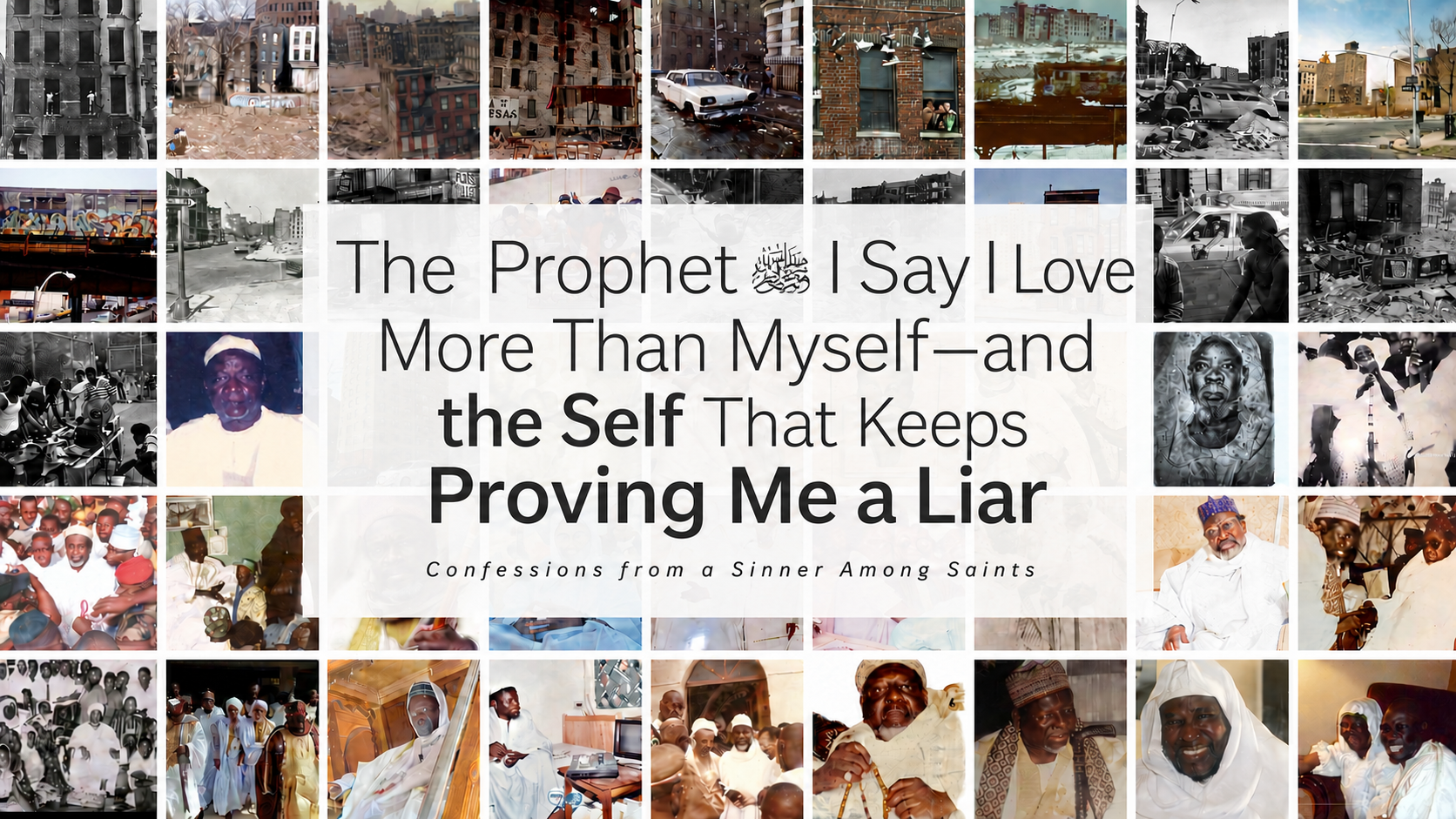
The Prophet I Say I Love More Than Myself—and the Self That Keeps Proving Me a Liar.
A Mawlid reckoning on love, ego, and the frightening distance between what I recite and what I obey*
By Ibrahim Dimson
Tonight is Mawlid.
Soon there will be lights.
There will be perfume and white garments. Plates will be passed. Voices will rise together in ṣalawāt. Someone will begin a poem we have heard a hundred times and, somehow, when the name Muḥammad ﷺ arrives at the right place in the verse, grown men will lower their heads.
Some will cry.
I may cry too.
But I have reached a point in my life where my tears no longer impress me.
That is difficult to admit.
I know what it means to be moved by the Messenger of Allah ﷺ. I know the warmth that comes over a gathering when his birth is remembered. I know what happens inside the chest when the poetry reaches that place where language almost gives up and only longing remains.
But I am no longer certain that being moved by him is the same thing as loving him.
And tonight, that difference terrifies me.
Because there is a question sitting beneath all the beautiful things we will do during Mawlid. Beneath the recitations. Beneath the lights. Beneath the food, the photographs, the clothes, the speeches, the poetry, the qasāʾid and the thousands of blessings we will send upon him.
It is an embarrassingly simple question.
Do I actually love Muḥammad ﷺ more than I love myself?
Not theoretically.
Not theologically.
Not poetically.
Me.
Ibrahim.
This particular man.
With this particular ego.
This history.
These ambitions.
These contradictions.
These appetites.
These wounds.
This need to be understood.
This instinct to defend myself.
This strange human addiction to being right even when being right destroys peace.
Do I love him more than myself?
For years, I could have answered that question immediately.
Of course.
I am Muslim.
I belong to a tradition saturated with love of the Messenger of Allah ﷺ. I follow a path in which ṣalāt upon him is not occasional decoration but spiritual oxygen. I have read the words of Shaykh Aḥmad al-Tijānī. I have sat with the teachings of Shaykh Ibrāhīm Niasse. I have heard people speak about the Prophet ﷺ until entire rooms seemed to become lighter.
Of course I love him.
But age does something uncomfortable to religious certainty.
Life does too.
Eventually Allah allows you to watch yourself long enough that your slogans begin losing their power.
I have watched myself.
I have watched Ibrahim when he is praised.
I have watched him when he is insulted.
I have watched him when money is involved.
I have watched him when an opportunity is slipping away.
I have watched him when somebody misunderstands his intentions.
I have watched him when he believes he has been betrayed.
I have watched him when his pride has been wounded and his intellect immediately begins constructing a magnificent legal defense for the ego.
I have spent much of my adult life building things, negotiating things, trying to turn improbable ideas into realities. That work can teach a man courage. It can also teach him control. You become accustomed to solving problems, directing outcomes, protecting your interests, persuading people, surviving disappointments and refusing to accept defeat.
Useful qualities in business.
Dangerous qualities in the soul.
Because eventually the Messenger of Allah ﷺ enters a part of your life where your executive authority means nothing.
And his Sunnah says:
Forgive.
My ego says: But let me explain what they did first.
He says:
Be gentle.
My ego says: They will interpret gentleness as weakness.
He says:
Give.
My ego begins calculating.
He says:
Lower yourself.
My ego produces a résumé.
He says:
Pardon.
My ego requests a trial.
He says:
Tell the truth.
My ego asks whether there might be a more strategically useful version of it.
And suddenly the question is no longer whether I love hearing about Muḥammad ﷺ.
The question is who gets obeyed when Muḥammad ﷺ and Ibrahim want different things.
That is where love becomes frightening.
---
There is a moment between the Prophet ﷺ and Sayyidunā ʿUmar ibn al-Khaṭṭāb that has refused to leave me.
The Prophet was holding ʿUmar's hand.
I try to imagine that.
ʿUmar—the towering man whose courage changed the atmosphere of Makkah, the man before whom men trembled—walking with his hand inside the blessed hand of the Messenger of Allah ﷺ.
And because ʿUmar was ʿUmar, he spoke honestly.
He said, in substance: You are more beloved to me than everything except myself.
Most of us would consider that a spectacular declaration of love.
Everything.
My family.
My possessions.
My position.
My comfort.
Everything except me.
But the Prophet ﷺ did not congratulate him.
He told him no.
Not yet.
Your faith will not be complete until I am dearer to you than your own self.
Then something extraordinary happens.
ʿUmar does not disappear for forty years.
There is no dramatic pilgrimage.
No long retreat.
No montage of spiritual exercises.
He looks again.
And he says:
By Allah, now you are dearer to me than myself.
And the Prophet ﷺ answers with two words that can split a human life in half:
“Now, O ʿUmar.”
Now.
I have thought about that word for a long time.
What changed?
The Prophet ﷺ did not change.
ʿUmar's history did not change.
The world around him did not change.
Something changed in how ʿUmar understood himself.
Perhaps he suddenly saw the absurdity of preferring the self that needed saving over the man Allah had sent to save it.
What has my ego ever done for me?
It has protected my pride while endangering my peace.
It has convinced me to rehearse injuries long after the people who caused them have gone to sleep.
It has made temporary things appear enormous and eternal things appear distant.
It has confused being admired with being worthy.
It has mistaken control for strength.
It has demanded vindication when mercy would have set me free.
And then there is Muḥammad ﷺ.
The man who stood at night until his feet swelled.
The man who was wounded and still prayed for people.
The man who buried children.
The man who knew hunger.
The man who was mocked, expelled, threatened and betrayed.
The man who conquered the city that had tortured him and answered victory with mercy.
The man who worried about an Ummah that had not yet been born.
Me among them.
Ibrahim.
Centuries later.
Still struggling with myself.
Still benefiting from a prayer I did not hear him make.
Still saying his name because he carried the truth through blood, hunger, loneliness and loss until it reached people whose faces he never saw.
So who exactly is more deserving of my loyalty?
The ego that keeps losing me?
Or the Prophet ﷺ who came to lead me home?
Perhaps this is what ʿUmar saw.
Perhaps preferring the Messenger ﷺ over yourself is not self-annihilation.
Perhaps it is the first sane act of self-preservation.
Now, O ʿUmar.
I hear those words differently today.
They no longer sound like something said only to him.
They sound like a door.
And I am standing outside it.
---
One of the dangers of religion is that we can learn the vocabulary of spiritual states we have never actually inhabited.
We know how lovers speak.
We know the poems.
We know when to raise our voices.
We know when to cry.
We know the names of saints.
We know the stories.
We know the formulas.
And if we are not careful, familiarity with the language of love can become a substitute for love itself.
The Prophet ﷺ taught that among the qualities by which a person tastes the sweetness of faith is that Allah and His Messenger become dearer to him than everything else.
I am fascinated by the word sweetness.
Sweetness cannot be explained into existence.
You can describe honey to a man for twenty years and he still has not tasted it.
And I wonder whether some of us—including me—have become expert lecturers on honey.
We describe.
We recite.
We commemorate.
We defend.
But have we tasted?
Because if Muḥammad ﷺ is truly more beloved to me than myself, that fact should be discoverable somewhere outside my mouth.
It should have evidence.
There should be casualties.
Some arrogance should have died.
Some resentment should have died.
Some appetite should have been told no.
Some relationship should have been repaired.
Some money should have left my hand that my ego wanted to keep.
Some apology should have escaped my lips without being followed by a paragraph explaining why I was still basically right.
Something in Ibrahim should have lost because Muḥammad ﷺ won.
Otherwise, what exactly am I claiming?
Even ṭarīqa cannot rescue us from this question.
Perhaps especially those of us who belong to a spiritual path need to ask it more ruthlessly.
A wird can live on the tongue while an empire of ego remains untouched beneath it.
We can pronounce the names of our shaykhs with tremendous pride while displaying almost none of their humility.
We can inherit a silsila and still refuse correction.
Spiritual lineage is not a medal declaring that I have arrived.
It is a rope thrown toward a drowning man.
My responsibility is to hold it.
Shaykh Ibrāhīm Niasse did not reduce love of the Prophet ﷺ to emotional ecstasy. In his Mawlid teaching, he connected that love to conduct: forgive those who wrong you, reconnect with those who sever ties, give to those who withhold from you, feed people, clothe people, welcome people.
That is where things become inconvenient.
It is easy to love the Prophet ﷺ inside a qasīda.
The qasīda has never insulted me.
It has never failed to return my telephone call.
It has never taken credit for something I did.
It has never owed me money.
It has never embarrassed me.
It has never misunderstood my intentions.
People do.
And apparently, according to the spiritual masters whose names I invoke, that is where my praise of the Prophet ﷺ is supposed to become flesh.
Not only in what I sing.
In how I behave after being wounded.
Baye Niasse wrote:
“The elixir for this slave is the love of Muḥammad, And my treasure is singing his praises.”
But Baye's praise did not float above life.
It entered life.
Love produced recognition.
Recognition produced imitation.
Imitation produced service.
And service made love credible.
That is the part I cannot escape.
---
I have begun to think that every human being has an invisible hierarchy of love.
We may not know its order.
But our choices know.
The heart keeps accounts.
We discover what we love most when two loves demand opposite things from us.
I love Allah.
I love His Messenger ﷺ.
I also love comfort.
I love dignity.
I love being respected.
I love my plans.
I love the things I build.
I love having some control over what happens next.
None of these loves is automatically evil.
But every one of them is capable of becoming a small god of preference inside the heart—not a god we worship with our foreheads, but something whose displeasure we fear enough to disobey Allah.
That is why the Qur'an names the things closest to us: fathers, sons, brothers, spouses, relatives, wealth, businesses whose decline we fear, homes in which we delight—and then asks what happens if these become dearer than Allah and His Messenger.
That verse is brutal because it does not condemn distant idols.
It names respectable things.
Family.
Money.
Business.
Home.
The architecture of an ordinary successful life.
The danger is not possessing them.
The danger is when they begin possessing the decision-maker inside us.
Prophetic love rearranges that hierarchy.
It does not require me to stop loving my family.
It teaches me how to love them.
It does not require poverty as theatre.
It teaches me what money is for.
It does not destroy ambition.
It purifies ambition from worship of the self.
It does not erase personality.
It disciplines personality until the soul can finally breathe beneath it.
That is why this Mawlid feels different to me.
I do not need another night on which I prove how beautifully I can celebrate his arrival into the world.
I need to know whether he has arrived in me.
---
Perhaps the most dangerous religious question is not:
Do you believe?
It is:
What has your belief changed?
So tonight I am trying to make my questions painfully specific.
Whom am I still refusing to forgive?
Where has pride disguised itself as principle?
Where am I demanding from people a mercy I expect from Allah but hesitate to extend myself?
What business decision would I make differently if I knew the Messenger ﷺ were standing beside me?
What conversation would change?
What would happen to my tongue?
My grudges?
My appetites?
My private conduct?
The way I treat someone who cannot do anything for me?
The way I behave toward a person after I no longer need them?
That last one haunts me.
Because character is clearest when usefulness ends.
Anyone can be gracious toward the powerful.
Anyone can be patient with someone whose signature they need.
The Muhammadan test begins when there is nothing to gain.
That is when mercy either exists or does not.
---
And still, I do not want this reflection to become despair.
There is another hadith.
Perhaps one of the most merciful sentences ever spoken to people like me.
“A person will be with those whom he loves.”
The Companions rejoiced when they heard it.
I understand why.
Because if admission into the company of the righteous depended on my resembling them before I could love them, I would have little hope.
But love itself becomes a rope.
Not sentimental love.
Not performance.
Truthful longing.
The broken man's love.
The sinner's love.
The love of someone who looks at the distance between himself and the Beloved ﷺ and is ashamed—but refuses to turn away.
That is the only place from which I know how to write this.
I am not writing as a man who has reached the station of ʿUmar.
I am writing as someone who has finally understood the question put to him.
There is a difference.
I stand outside that now.
I can see the door.
Some days I move toward it.
Other days my ego drags furniture in front of it.
But at least I know what the struggle is now.
And maybe that itself is a mercy.
---
Tonight people will gather around the world.
Children will fall asleep against their mothers while men continue reciting.
Tea will be poured.
Perfume will move through crowded rooms.
Somewhere an old man will begin a poem from memory.
Somewhere a young man who has made a mess of his life will whisper ṣalawāt because he has nowhere else to go.
Somewhere a woman carrying a grief nobody knows about will hear the Prophet's name and feel less alone.
Somewhere a sinner will remember that the door is still open.
And perhaps that is part of the mystery of Mawlid.
We celebrate a birth that happened more than fourteen centuries ago, yet something keeps being born.
Hope.
Longing.
Repentance.
The desire to try again.
But this year I want more.
I do not simply want to remember the night Muḥammad ﷺ entered the world.
I want to remember the places inside Ibrahim where he has not yet been allowed to enter.
The room called pride.
The room called resentment.
The room called appetite.
The room called reputation.
The room called control.
The room where I keep all the explanations for why the Sunnah is unquestionably correct in principle but exceptionally difficult in my particular circumstance.
Those are the rooms that need Mawlid.
Because Mawlid is not merely memory.
Mawlid is a mirror.
And I do not like everything I see inside it.
I see a man capable of abundant ṣalawāt and insufficient patience.
A man who understands mercy more easily when he is the one who needs it.
A man who wants proximity to saints but still resists the humiliations by which saints are made.
A man who says that Muḥammad ﷺ is more beloved to him than everything while still negotiating, almost daily, with the sovereignty of his own ego.
But I see something else too.
A road.
Knowledge.
Ṣalawāt.
Repentance.
Service.
Sunnah.
Humility.
Beginning again.
Again.
Again.
Until perhaps preference becomes instinct.
Until perhaps the hand reaches automatically for mercy.
Until perhaps the tongue learns silence.
Until perhaps forgiveness becomes cheaper than resentment.
Until perhaps I stop protecting a version of myself that the Messenger of Allah ﷺ came to liberate me from.
I do not know whether I will ever reach the station of ʿUmar.
I will not insult that station by pretending.
But I can stand where he once stood.
I can tell the truth.
I can admit that there remain things inside me that I prefer to obedience.
I can admit that sometimes I still love Ibrahim too much.
And I can ask Allah—with all the poverty I possess—to rearrange me.
O Allah, let me love Your Messenger ﷺ more than my need to win.
More than my pride.
More than my reputation.
More than money.
More than applause.
More than grievance.
More than appetite.
More than comfort.
More than the version of myself I have spent a lifetime defending.
Let that love become visible.
Put it in my transactions.
Put it in my home.
Put it in my speech.
Put it in the way I forgive.
Put it in how I treat the weak.
Put it in what I do when nobody knows.
Put it in the moment when Ibrahim wants one thing and Muḥammad ﷺ taught another.
And in that moment, let love decide.
Perhaps then Mawlid will cease to be merely the celebration of a birth.
Perhaps it will become the anniversary of a death:
the slow death of the self that believed it had to remain king.
And perhaps somewhere beyond that death is the life I have been asking Allah for all along.
A life in which the statement I have repeated so easily finally becomes true:
I love him more than myself.
And perhaps, through grace alone, one day the answer will come—not from my mouth, but from the evidence of my life:
Now, O Ibrahim.
Now.